
You’re running a solid business in Central Texas. Your service is great. Your customers love you. But when someone three blocks away searches for exactly what you offer, they’re finding your competitor instead.
Here’s the thing: 32% of consumers search for local businesses every single day. If you’re not showing up in those searches, you’re invisible to the exact people who are ready to walk through your door or pick up the phone.
Local SEO isn’t just for the big Austin tech companies. It’s for the Round Rock coffee shop, the Georgetown HVAC contractor, and the North Austin boutique. It’s how you make sure your business appears when it matters most, when someone nearby needs what you offer right now.
Let’s break down exactly how to dominate local search in Central Texas.
Start With Your Google Business Profile (It’s Your Digital Storefront)
Think of your Google Business Profile as your storefront on the busiest street in Central Texas, Google Search. When someone searches “plumber near me” or “best tacos in Round Rock,” Google pulls information directly from these profiles.
Here’s what you need to nail:
Get your basics bulletproof. Use your exact legal business name, a local phone number (512 or 737 area code signals you’re actually here in Central Texas), complete business hours, and your primary category. Don’t guess on the category, choose the one that most accurately describes your core business.
Add secondary categories. You get up to nine additional categories, and you should use them. A coffee shop might add “Bakery,” “Breakfast Restaurant,” and “Wi-Fi Spot.” A law firm could include “Estate Planning Attorney” and “Family Law Attorney.” These extra categories help you appear in more specific searches.
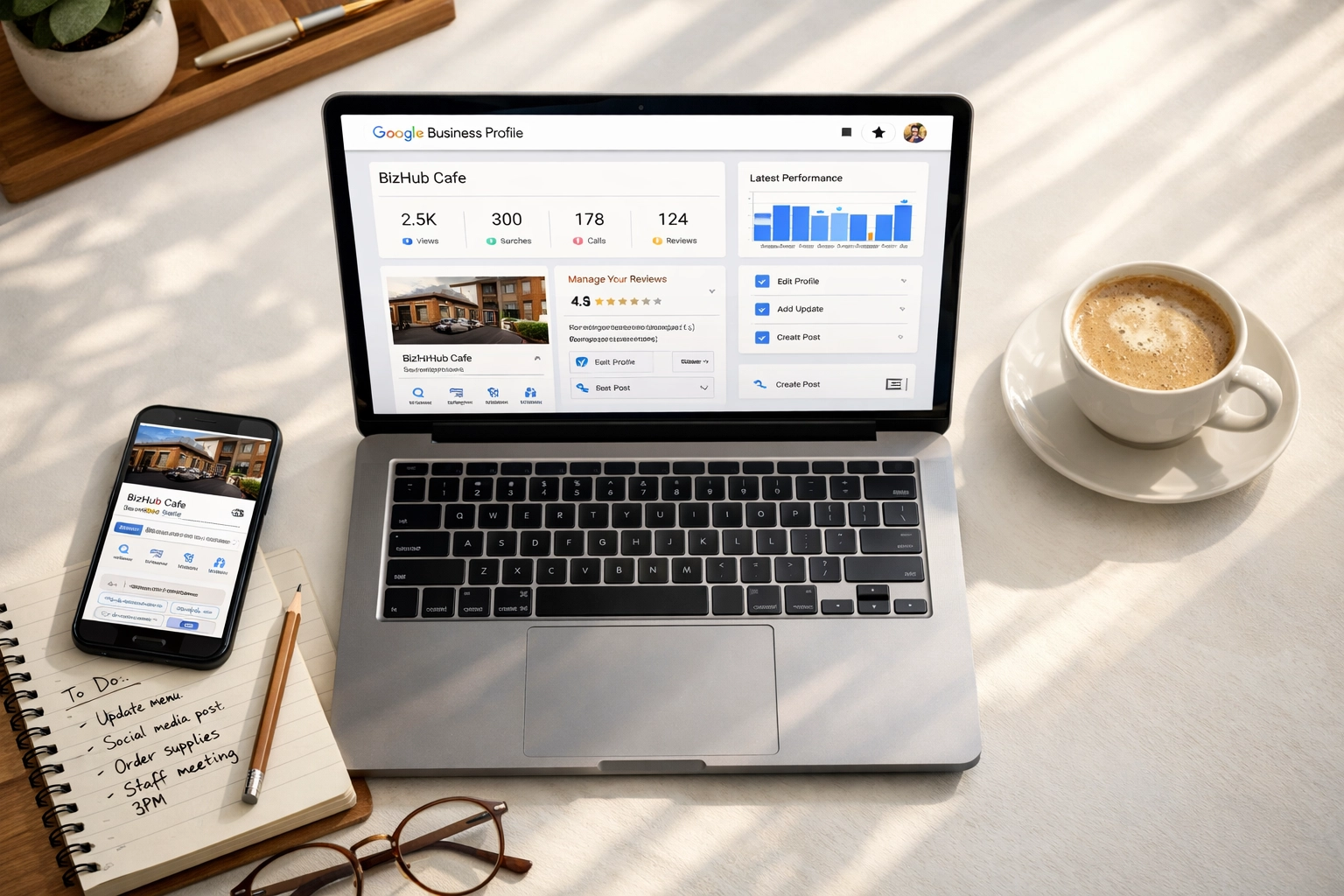
Upload real photos regularly. Businesses with photos get 42% more requests for directions and 35% more clicks to their websites. Show the inside of your shop, your team, your products, your storefront. Use images that feature local landmarks and scenery when it makes sense, it reinforces that you’re genuinely part of the Central Texas community.
Keep your info updated. Changed your hours for the holidays? Update it immediately. Added a new service? Add it to your profile. Google rewards businesses that actively maintain their profiles with better visibility.
Master Location-Specific Keywords (Talk Like Your Customers Search)
Here’s what most Central Texas businesses get wrong: they optimize for “best coffee shop” when their customers are actually searching for “coffee shop near Mueller” or “Georgetown coffee with outdoor seating.”
You need to think in three layers:
Your core terms are your primary offering: coffee shop, plumber, dentist, yoga studio, car repair, landscaper.
Your modifiers add specificity: affordable, emergency, 24/7, organic, family-friendly, same-day.
Your local identifiers are what make you discoverable in Central Texas: neighborhood names (Hyde Park, Domain, East Austin, Old Town Georgetown), districts, and even local landmarks.
Put them together and you get: “emergency plumber in Round Rock” or “family-friendly brunch in Mueller” or “affordable dentist near Georgetown Square.”
The key is to research how people in your specific area actually search. Someone in Round Rock might reference “near the Dell Diamond.” Someone in Georgetown talks about “near the Square.” Austin has dozens of distinct neighborhoods, each with its own search patterns.
Create Content That Speaks to Each Area You Serve
If you serve multiple Central Texas communities, don’t lump them all together on one generic “Service Areas” page. Create dedicated pages or content sections for each location, and make them genuinely useful.

For example, if you’re an HVAC company serving the whole region, you might create:
A Round Rock page that talks about the climate challenges in newer suburban homes, mentions the rapid growth in the area, and references local landmarks people would recognize.
A Georgetown page that addresses the unique needs of historic homes downtown versus newer developments on the outskirts.
An Austin page that might break down further into neighborhoods, addressing the different housing stock and needs in East Austin versus Hyde Park versus the Domain area.
This isn’t about keyword stuffing. It’s about showing Google (and your potential customers) that you understand the specific communities you serve. You’re not some faceless corporation, you’re a local business that knows the difference between North Austin’s tech corridor vibe and South Austin’s artistic community.
Build and Manage Your Review Reputation
Here’s an uncomfortable truth: your future customers trust strangers on the internet more than they trust your marketing. Reviews are social proof, and Google uses them as a major ranking factor for local search.
Ask for reviews systematically. After a successful service call, send a follow-up email with a direct link to your Google review page. Make it easy. Most happy customers are willing to leave a review, they just need to be asked.
Respond to every review. Thank people for positive reviews. Address negative reviews professionally and offer to make things right. This shows future customers that you’re actively engaged and care about the experience you provide.
Showcase reviews on your website. Don’t let those great testimonials live only on Google. Feature them prominently on your site, it builds trust and keeps visitors engaged longer.

Get Your Citations Consistent Everywhere
Citations are mentions of your business name, address, and phone number (NAP) across the web, directories, social media, industry sites, local business listings.
Google uses these citations to verify that your business is legitimate and to determine where you’re located. But here’s the catch: they need to be exactly consistent.
If your Google Business Profile says “Smallworks Web Design” but your Facebook page says “Small Works Web Design” and your Yelp listing says “Smallworks Web Design LLC,” Google gets confused. It can’t confidently verify your information, which hurts your local rankings.
Do an audit of everywhere your business appears online. Make sure your business name, address, and phone number are identical everywhere. Yes, it’s tedious. Yes, it matters.
Optimize for Mobile (Because That’s Where Local Search Happens)
Half of Central Texas consumers who find a business on mobile visit it within 24 hours. Think about how you personally search when you need something: you pull out your phone and type “near me.”
Your website needs to work flawlessly on mobile:
Fast load times. If your site takes more than three seconds to load, half your visitors are gone. Compress images, minimize code, and test your site speed regularly.
Easy navigation. Big, touch-friendly buttons (at least 44 pixels). Simple menus. No tiny text that requires pinching and zooming.
Click-to-call phone numbers. Make it absurdly easy for someone to call you directly from your website.
Voice search optimization. Add an FAQ section that uses conversational language. Instead of “HVAC repair services Austin,” think “What should I do when my air conditioner stops working in the summer?” Voice searches are three times more likely to be local, and they use natural question formats.
Connect With Your Local Community (Online and Off)
Google rewards businesses that are genuinely embedded in their communities. There are practical ways to demonstrate this online:
Write about local events and news. Published a blog post about preparing homes for Austin’s summer heat? That’s locally relevant content. Talking about small business trends in Round Rock? Same thing.
Use location-based tags on social media. When you post, include relevant hashtags: #AustinTX, #RoundRockTX, #GeorgentownTX, #ATX. If you’re participating in local events (SXSW, Round Rock Donuts Day, Georgetown’s Red Poppy Festival), tag them.
Feature your community involvement. Sponsor a local Little League team? Participate in a community cleanup? Donate to local causes? Talk about it. This isn’t bragging: it’s showing you’re invested in the area beyond just extracting profit.

Add Services and Products With Searchable Names
On your Google Business Profile, you can list specific services and products. Don’t waste this opportunity with vague descriptions.
A restaurant shouldn’t just list “Food”: list “Breakfast Tacos,” “Craft Beer Selection,” “Gluten-Free Options,” “Weekend Brunch.” An HVAC company shouldn’t just say “Repair”: specify “Emergency AC Repair,” “Furnace Installation,” “Duct Cleaning,” “24-Hour Service.”
Use descriptive, keyword-rich names that match how people actually search. These appear in your profile and give Google more signals about what you offer and when to show you in search results.
Local SEO Is Your Long-Term Growth Strategy
Here’s the fundamental difference between local SEO and other marketing channels: SEO compounds over time, while paid ads stop working the moment you stop paying.
Every piece of locally-optimized content you create, every review you earn, every citation you build: they keep working for you month after month. You’re building a digital asset that grows stronger as you invest in it.
Is it work? Absolutely. Does it require consistency? Yes. But for Central Texas small businesses competing in increasingly crowded markets, it’s the difference between hoping customers find you and ensuring they find you when they’re ready to buy.
Need help getting your Central Texas business visible in local search? We’ve helped dozens of Austin-area businesses dominate their local markets. Let’s talk about your local SEO strategy and get you showing up where it matters most: right when your neighbors are searching for what you offer.