
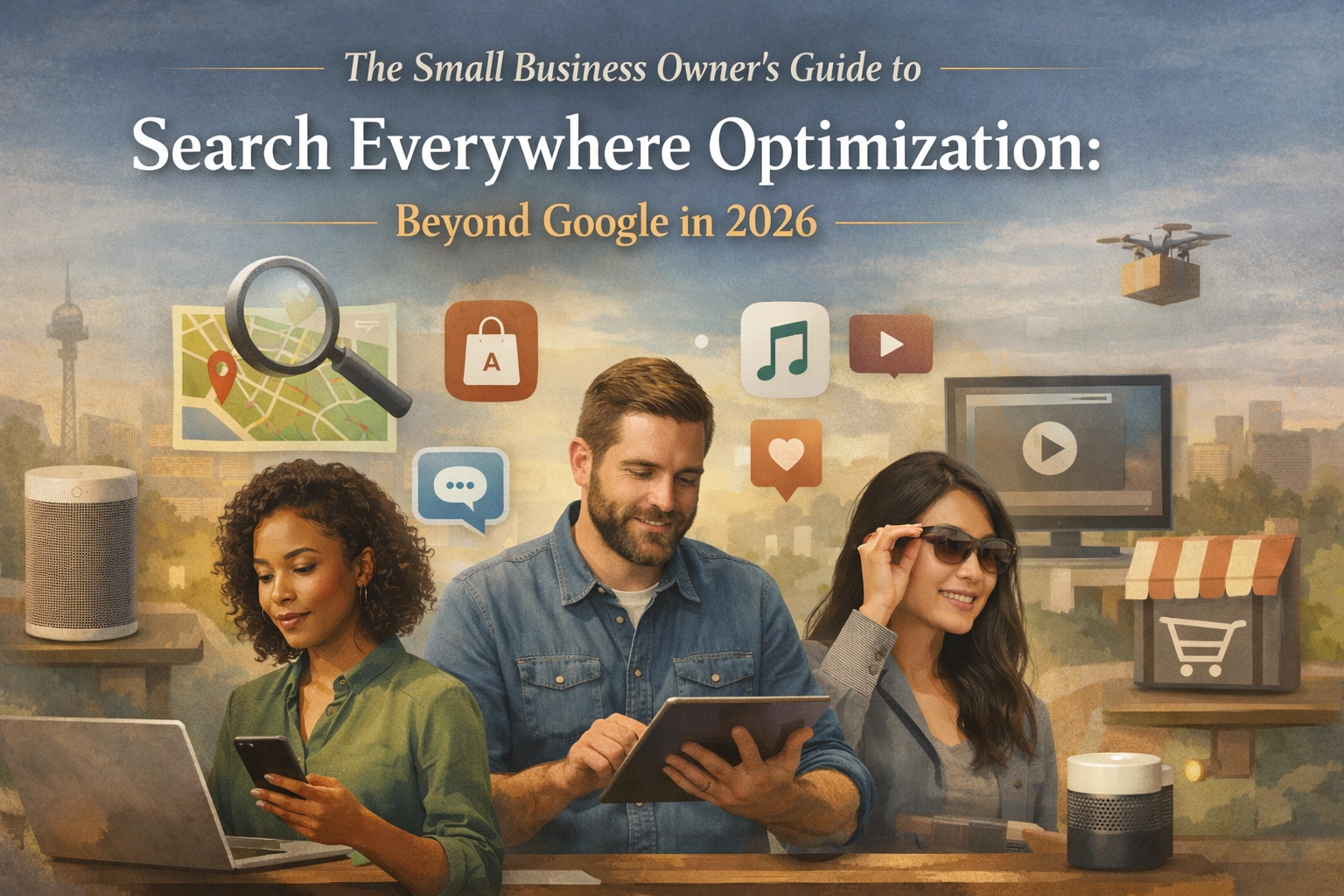
You’ve probably noticed something shifting in how your customers find you. They’re not just Googling anymore: they’re asking ChatGPT, searching on TikTok, scrolling through Instagram, and diving into YouTube tutorials. Your customers are searching everywhere, and if your business is only optimized for traditional Google search, you’re missing a huge chunk of potential clients.
Welcome to 2026, where search isn’t confined to a single search bar. It’s fragmented across platforms, powered by AI, and happening in places you might not even realize. Let’s talk about how to show up where your customers are actually looking.
The Search Landscape Has Exploded
Remember when SEO meant getting to the top of Google? Those days aren’t gone, but they’re no longer the whole story. Your potential customers are starting their search journeys in dozens of different places, and each one has its own rules, algorithms, and opportunities.
Think about your own behavior. When you want to learn how to fix something, you probably head to YouTube. When you’re looking for restaurant recommendations, you might check Instagram or ask an AI chatbot. When you need a local service, you’re likely checking Google Maps or reading reviews on multiple platforms.
Your customers are doing the same thing. They’re starting searches on social platforms, asking AI assistants, watching video content, and reading reviews before they ever visit a website. If your small business isn’t visible across these channels, you’re essentially invisible to a growing portion of your target market.

Platform SEO Is the New Frontier
Here’s where things get interesting. Platform SEO means optimizing your presence on each individual platform where your customers hang out. This isn’t about being everywhere: it’s about being strategic about where your specific audience searches.
For most small businesses, this breaks down into three key areas:
Video Search Optimization is non-negotiable in 2026. YouTube isn’t just a social platform: it’s the second largest search engine in the world. If you’re not creating video content that answers your customers’ questions, you’re leaving money on the table. And we’re not talking about polished commercials. Simple, helpful videos shot on your phone that solve real problems perform better than overproduced content.
Social Platform Discovery has become a primary search method. People search on Instagram, TikTok, Facebook, and LinkedIn looking for businesses, solutions, and recommendations. Your profile optimization, hashtag strategy, and content consistency directly impact whether you show up in those searches.
Local Platform Visibility extends beyond Google Business Profile. Yelp, Nextdoor, industry-specific directories, and local community platforms all have their own search functions. Your customers are checking multiple sources before making decisions, which means your business information needs to be accurate and optimized everywhere.
AI Is Changing How People Find Answers
This is the big shift happening right now. AI-powered search tools are mediating how customers discover businesses, and the rules are different from traditional SEO.
When someone asks ChatGPT, Claude, or Gemini for a recommendation, these tools aren’t just pulling from search rankings: they’re synthesizing information from across the web, prioritizing authoritative sources, and presenting answers directly. Your goal isn’t to rank #1 anymore. Your goal is to be the source that AI tools reference when answering questions related to your expertise.

How do you optimize for this? Start by becoming a cited authority in your niche. This means:
Creating in-depth content that thoroughly answers specific questions rather than surface-level blog posts targeting keywords. AI tools favor comprehensive, accurate information over keyword-stuffed fluff.
Building your presence on platforms where AI tools gather data: your website, YouTube, LinkedIn articles, and industry publications. The more places you provide valuable information, the more likely AI will reference you.
Focusing on local and niche expertise rather than trying to compete on broad topics. AI increasingly prioritizes specialized knowledge, which plays perfectly into small business advantages.
The Core Principles That Work Everywhere
Despite all these different platforms and AI-driven changes, certain optimization principles remain constant. Relevance, quality, user experience, and authority matter whether you’re optimizing for Google, YouTube, or AI-powered search tools.
Relevance means matching your content to what people are actually searching for. This requires understanding your customers’ questions, pain points, and the exact language they use when looking for solutions. Generic content doesn’t cut it anymore: specificity wins.
Quality is about depth and accuracy. A 500-word blog post covering something superficially won’t compete with a 1,500-word guide that thoroughly addresses the topic. AI tools and search algorithms both prioritize comprehensive content that genuinely helps people.
User experience translates across platforms as making things easy. Fast-loading pages, mobile-friendly design, clear navigation, accessible content: these fundamentals matter whether someone finds you through Google or an AI recommendation. If you need help with website design that delivers great experiences, that’s exactly what we do.

Authority signals come from reviews, backlinks, mentions, and consistent presence. When your business appears across multiple platforms with positive reviews and quality content, both traditional search engines and AI tools recognize you as trustworthy.
Building Your Search Everywhere Strategy
So how do you actually implement this without spending 40 hours a week on marketing? Start with these practical steps:
Audit your current visibility across platforms. Google your business, check YouTube, search on social platforms, and see where you appear. Note what’s working and what’s missing. This gives you a baseline and helps you prioritize.
Claim and optimize every relevant profile. Google Business Profile, Facebook, Instagram, LinkedIn, YouTube, Yelp, Nextdoor: whatever makes sense for your industry. Consistent information across all platforms builds trust and improves visibility.
Create one piece of quality content weekly that can be repurposed across platforms. A detailed blog post becomes a YouTube video, an Instagram carousel, a LinkedIn article, and multiple social posts. You’re not creating more work: you’re maximizing one piece of effort.
Prioritize platforms where your customers actually search. Don’t spread yourself too thin. If you’re a B2B service, LinkedIn and Google matter more than TikTok. If you’re a consumer brand, visual platforms might be your priority. Focus your energy where it actually drives results.
Build your review presence systematically. Reviews aren’t just social proof: they’re search fuel. They appear in search results, influence AI recommendations, and provide fresh content that search engines love. Making review collection part of your standard process pays dividends across every platform.
The Local Advantage in a Fragmented Search World
Here’s the good news: as search fragments across platforms and AI tools, local expertise becomes more valuable, not less. You’re not competing with massive national brands on every platform: you’re establishing yourself as the go-to expert in your area.
Someone asking an AI chatbot for “the best web designer in Central Texas” or searching YouTube for “small business SEO tips in Austin” is looking for specific, local expertise. That’s your opportunity. When you combine platform visibility with local focus, you create a powerful advantage that big competitors can’t easily replicate.
If you’re realizing your website needs work to support this multi-platform strategy, a website redesign might be your starting point. Your website remains the hub that everything else points back to: it just can’t be your only presence anymore.

Start Where You Are, Build From There
The shift to search everywhere optimization might feel overwhelming, but you don’t need to master every platform overnight. Start with the foundations: an optimized website, claimed business profiles, and one platform where your customers actively search.
The businesses winning in 2026 aren’t necessarily doing the most: they’re doing the right things consistently across the channels that matter to their specific audience. That’s something any small business can achieve with the right strategy.
Your customers are searching everywhere. The question is: will they find you?