
You know the feeling: you spend hours perfecting a listing, only to see it buried under ten pages of Zillow, Redfin, and Realtor.com results. It feels like you’re shouting into a void, trying to compete with billion-dollar companies for the same generic keywords like “homes for sale in Austin.”
But here’s the secret: the big portals are great at the “big picture,” but they’re actually pretty terrible at the small stuff. In 2026, the real estate game isn’t won by owning the whole city; it’s won by owning the street corner. This is where neighborhood-level SEO comes in. It’s your way to stop fighting for scraps and start building a 24/7 marketing machine that works while you’re out showing houses.
Why Hyperlocal is Your Superpower in 2026
About 70% of Google searches are now long-tail keywords. People aren’t just searching for “houses” anymore. They are asking their AI assistants: whether it’s Gemini, GPT-5, or a dedicated search engine like Perplexity: very specific questions. They want to know about “3-bedroom mid-century moderns in Mueller with walkable coffee shops” or “quiet cul-de-sacs in Round Rock with the best elementary schools.”
The big national sites can’t provide the “vibe check” that a local expert can. AI search engines in 2026 prioritize original, human-first insights. They are looking for the agent who actually knows which neighborhood has the best food truck Friday or where the traffic gets hairy at 5:00 PM. By focusing on the neighborhood level, you aren’t just a realtor; you become the definitive digital authority for that specific patch of land.
The Hub-and-Spoke Framework
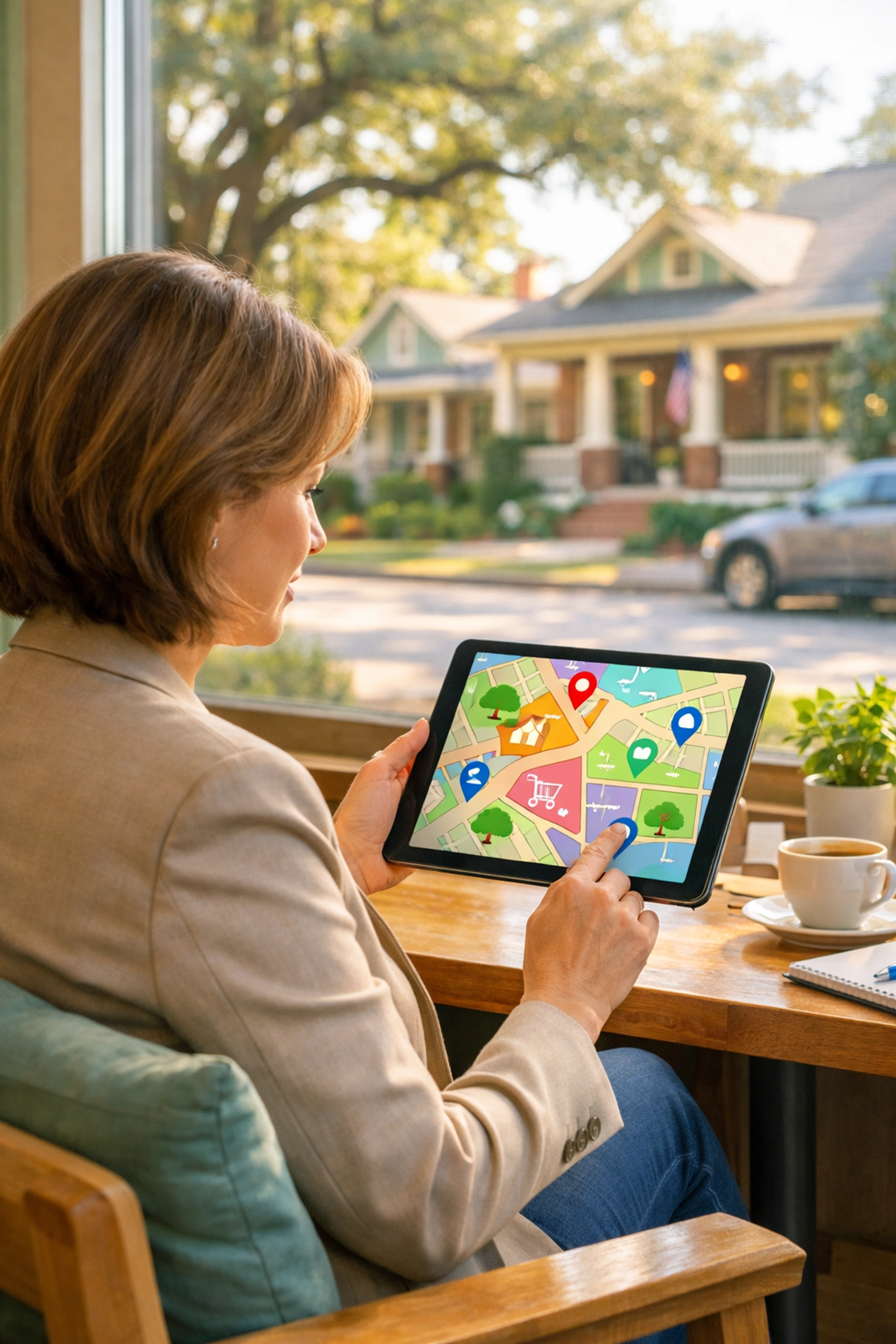
To dominate local search, you need a strategy called the Hub-and-Spoke model. Think of it like a wheel. The center (the Hub) is your main city page, and the spokes are your individual neighborhood guides.
1. The Hub Page
This is your “Complete Guide to Austin Neighborhoods” (or Round Rock, or Cedar Park). It’s a high-level overview that links out to everything else. It tells Google, “I know this entire area inside and out.” You can learn more about how we structure these high-performing sites on our website design page.
2. The Spoke Pages (Neighborhood Guides)
These are deep dives. We’re talking 1,500 to 2,000 words about a specific neighborhood like Cherrywood or Avery Ranch. A good guide isn’t just a list of houses; it needs to cover:
- The Vibe: Is it artsy? Quiet? Corporate?
- Home Trends: What are the price points and architectural styles?
- Amenities: Parks, gyms, and the best places to grab a taco.
- Commute Times: Be honest about the traffic!
- Schools: Go deeper than just the rating: mention the community involvement.
When you create these “Spokes,” you’re providing the exact data that AI search engines crave. While Zillow shows a map, you are telling a story.
The Magic of Comparison Content
One of the biggest missed opportunities in real estate SEO is comparison content. Prospective buyers are almost always torn between two or three areas. They’re asking, “Should I buy in Circle C or Steiner Ranch?”
By writing a “Circle C vs. Steiner Ranch” article, you are catching buyers at the peak of their decision-making process. These articles are easier to rank for than general terms because they are so specific. Plus, they allow you to link back to both of your neighborhood guides, which boosts your overall site authority. If your current site isn’t ranking for these types of terms, it might be time for a website redesign to fix your content structure.

How AI Search is Changing the Rules
In 2026, “SEO” doesn’t just mean keywords anymore. It means Topical Authority. Google’s AI doesn’t just count how many times you say “Realtor in Round Rock.” It looks at the interconnectedness of your content.
If you have a guide for a neighborhood, a comparison article, and a blog post about the local school district’s new boundary changes, Google sees a pattern. It realizes you are the most knowledgeable source for that area. When someone asks an AI search tool, “Who is the best agent for the North Loop area?” the AI will recommend you because you’ve provided the most comprehensive data set.
This is a core part of our SEO service. We don’t just sprinkle keywords; we build a web of authority that makes you the obvious choice for both humans and algorithms.
Don’t Forget the Technical “Boring” Stuff
Even the best neighborhood guide will fail if your site is slow or hard to navigate. In 2026, performance standards like Interaction to Next Paint (INP) are huge. If a user clicks on your map and it takes three seconds to respond, they’re gone: and Google will notice.
You also need Local Schema Markup. This is a bit of code that tells search engines exactly what your business is, where you are, and what areas you serve. It’s like a digital business card that search engines can read instantly. Without it, you’re making the AI guess, and AI hates guessing. You can check out our website maintenance options to ensure your technical foundation is always solid.
Your Implementation Timeline
Building a neighborhood-level SEO empire doesn’t happen overnight, but it compounds faster than you think.
- Months 1-3: Build your Hub page and your first 5-10 neighborhood guides. Focus on the areas where you’ve recently closed deals. You have the most “on the ground” knowledge here.
- Months 4-6: Start adding comparison articles. “Neighborhood A vs. Neighborhood B.” This is where you’ll start seeing your first organic leads trickle in.
- Months 6-12: This is the inflection point. Once you have about 15-20 interconnected guides, new content will start ranking almost instantly. You’ll find yourself owning page one for local terms that used to be dominated by the big portals.
Let’s Get Hyperlocal
The real estate market in 2026 is noisier than ever. Paid ads are getting more expensive, and the big platforms are getting more crowded. The only way to win is to go where they can’t: into the heart of the neighborhood.
By building a site that actually helps people understand the community, you aren’t just “doing SEO.” You’re building trust before you even pick up the phone. You’re showing potential clients that you don’t just sell houses; you understand the lifestyle they’re looking for.
If you’re ready to stop shouting into the void and start owning your local market, we’re here to help. Whether you need a fresh website design or a deep-dive SEO strategy, we can build the engine that drives your business forward.

Imagine waking up to a notification that a high-intent buyer just spent twenty minutes reading your guide to Southwest Austin and now wants to book a tour. That’s the power of neighborhood-level SEO. It’s a long-term play, but it’s the most stable, profitable asset you can build for your business.
Ready to claim your territory? Reach out to us and let’s talk about how to make you the go-to expert in your favorite neighborhood. The “big guys” might have the budget, but you have the local heart: and in 2026, that’s exactly what people (and search engines) are looking for.